You stepped on the scale this morning and the number did not move. Or worse, it went up slightly. And just like that, the workout you completed yesterday, the meal you prepared instead of ordering takeout, the water you drank consistently all week, all of it felt meaningless.
This is the problem with making the scale your primary way to track fitness progress. It is one number, and it captures that number imperfectly, because it shifts by one to two kilograms (about 2 to 4 pounds) on any given day based on water retention, digestion, hormonal cycles, sodium intake, and sleep quality. Here are ten far more meaningful ways to track fitness progress that the scale will never show you, plus a simple starting test so you know where you begin.
How to Track Fitness Progress Without a Scale: The Short Answer
Test your starting point first (resting heart rate, body measurements, push-ups, plank time, and a simple walk or run time). Then log every workout, take progress photos and tape measurements once a month, and retest every 4 to 6 weeks.
Strength, endurance, measurements, how your clothes fit, energy, and sleep tell you far more about your fitness than your weight does.
The scale is not useless, but it is deeply incomplete as a sole measure of progress. For many people it is actively harmful, creating a feedback loop where one discouraging number derails days of genuine effort. If you also want to lose weight, read our guide on how to lose weight fast without exercise.
Ten Ways to Track Fitness Progress Beyond the Scale
Track Your Strength and Performance Numbers
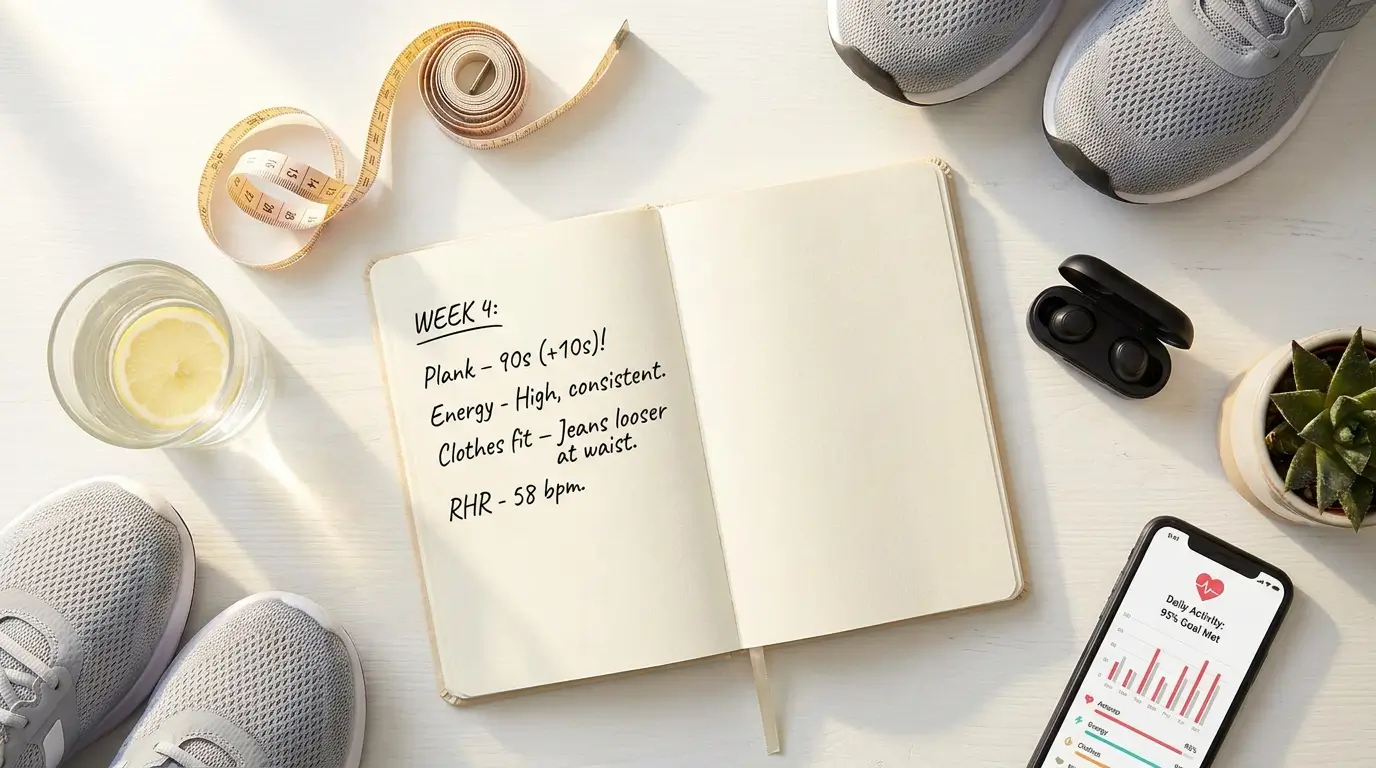
This is the most objective, most motivating, and most reliable measure of fitness progress available, and almost nobody uses it. Every time you exercise, write down what you did. For bodyweight workouts, record reps, hold times, and variations. For weights, record load and reps. For walking or running, record distance and time.
Then compare across weeks. Performance tracking is motivating in a way the scale rarely is, because it shows you what your body is now capable of, and that capability only moves in one direction when you train consistently.
Take Monthly Progress Photos
Progress photos are one of the most powerful visual tools available, but only when used correctly.
- Same time of day, every time. First thing in the morning before eating works best
- Same lighting, natural light from the same direction
- Same clothing, ideally minimal
- Same pose: front, side, and back views
- Same distance from the camera
Compare month one to month three, not week to week. Someone who has gained two kilograms of muscle while losing two kilograms of fat looks dramatically different: leaner, more toned, with better posture. The scale shows zero change. The photos show everything.
Measure Your Body With a Tape Measure
Body measurements capture body composition changes that the scale completely misses. Take these once per month:
- Chest, across the fullest part
- Waist, at the narrowest point, about two centimeters (one inch) above the navel
- Hips, at the widest point
- Upper arm, around the bicep at its largest point, relaxed
- Thigh, around the largest part of the upper thigh
- Calf, around the widest point
When your waist drops three centimeters (more than one inch) over eight weeks, even with no change on the scale, that tells you clearly that you have lost fat from around your midsection.
Notice How Your Clothes Fit
This is the most immediate, most practical, and most consistently honest feedback mechanism available. You experience it every single day without any equipment at all. The jeans that felt tight around the waist two months ago now fit comfortably. The shirt that pulled across the shoulders now drapes properly.
Keep one specific item as a reference: the jeans, the fitted shirt, the dress. Try it on once a month and notice the difference. This is more meaningful feedback than stepping on a scale every morning.
Track Your Resting Heart Rate
Your resting heart rate is one of the best indicators of cardiovascular fitness available, and most smartphones and fitness trackers measure it automatically. Measure it first thing in the morning before getting out of bed. A normal resting heart rate for adults is generally 60 to 100 beats per minute, and fitter people often sit at the lower end.
Assess Your Energy Levels Throughout the Day
This one requires no measurement tool, just honest daily self-observation. Ask yourself weekly: do you wake up feeling more rested than a month ago, does the afternoon energy crash feel less severe, do you have more capacity for your evening rather than collapsing on the sofa, do stairs and groceries feel noticeably easier?
Improved energy and daily function are direct products of improved fitness, felt every hour of every day, and the scale just is not showing you that story.
Notice Changes in Sleep Quality
Sleep quality is both a driver and a result of fitness improvement. When cardiovascular fitness improves and body composition shifts, deep sleep tends to increase, time to fall asleep decreases, and night waking reduces.
Ask yourself monthly: how long does it take to fall asleep compared to two months ago, are you waking less at night, do you feel genuinely rested when your alarm goes off? If the answers trend the right direction, your fitness is improving regardless of what the scale says. For more on this, read Sleep and Fitness: Why Rest Days Matter.
Track Flexibility and Mobility Improvements
Take a simple baseline test at the start of your fitness journey, then retest every four weeks:
- Stand and bend forward: how close do your fingertips get to the floor
- Can you reach your arms fully overhead without your lower back arching
- Can you sit comfortably cross-legged on the floor
- How far can you comfortably turn your neck to each side
Being able to touch the floor for the first time in years, or sitting comfortably cross-legged without hip pain, are genuine physical achievements the scale tells you absolutely nothing about.
Monitor Your Workout Recovery Time
After a workout, how long does it take for your breathing to return to normal? In week one, a 20-minute cardio session might leave you breathless for several minutes afterward. Six weeks later, your breathing returns to normal within 90 seconds of the same session.
This improvement in recovery speed is a direct measure of cardiovascular enhancement, your heart and lungs clearing the oxygen debt faster than before, and it happens regardless of what the scale reads.
Keep a Weekly Wellbeing Journal
This final method is the most holistic and often the most revealing over time. Each week (Sunday evening works well), spend five minutes writing brief answers to a few questions: what physical achievement am I most proud of this week, how did my body feel during exercise compared to last week, what daily activity felt easier this week, how are my mood and mental clarity, what do I want to build on next week?
Reading back through six to eight weeks of entries shows a story of progress that no single measurement can capture. That story, your actual story of physical and mental improvement, is your real fitness progress. The scale is a footnote.
Basic Fitness Assessments to Find Your Starting Point
To get the best results from any workout plan, evaluate your starting point first, then track progress from there. A fitness evaluation does not need a lab. These simple assessments and body measurements take about 20 minutes, need almost no equipment, and give you a baseline to beat in four to six weeks.
| Assessment | How to do it | What to record |
|---|---|---|
| Resting heart rate | Sit quietly for 5 minutes (or measure on waking), then count your pulse for 60 seconds. | Beats per minute |
| Body measurements | Use a soft tape on the chest, waist, hips, upper arm, and thigh. Do not pull the tape tight. | Centimeters or inches for each spot |
| Push-up test | Do as many push-ups with good form as you can without stopping. Use knee or incline push-ups if full ones are too hard. | Number of reps and which version |
| Plank hold | Hold a forearm plank with a straight line from head to heels until your form breaks. | Time in seconds |
| Chair stand or squat test | Stand up from a chair and sit back down (or do bodyweight squats) as many times as you can in 30 seconds. | Number of reps |
| Flexibility (toe touch) | Stand, bend forward with straight legs, and see how far your fingertips reach. | Distance above or below your toes |
| Cardio endurance | Walk (or jog) 1 mile (1.6 km) at a steady, hard effort on flat ground. | Total time and how hard it felt |
Write every result down with the date. Retest every 4 to 6 weeks under the same conditions, at the same time of day, and compare your numbers with your own past results, not with other people. Stop any test if you feel dizzy, feel chest pain, or have sharp pain, and talk to a doctor before testing if you have a heart condition or other health concern.
Two Exercises to Help You Do More Push-Ups
If your push-up test number is low, do not worry. It is the easiest score to raise. Two exercises build the strength behind a push-up better than anything else:
- Incline push-ups (or knee push-ups): Put your hands on a sturdy counter, bench, or sofa and do push-ups from there. This lets you practice the full movement with less body weight. Lower the surface over a few weeks until you can do them from the floor.
- Forearm planks: Planks train your chest, shoulders, arms, and core to stay rigid, which is exactly what a good push-up needs. Start with 15 to 20 seconds and add 5 seconds each week.
Do both two to three times a week with a rest day in between, and log your reps and hold times. This is a perfect example of progress the scale will never show you.
After a Fitness Evaluation: 5 Steps to Improve Your Results
Testing only helps if you act on the numbers. Once you finish your assessments, follow these five steps:
- Find your weakest area. Look at which test felt hardest: strength, endurance, flexibility, or heart rate recovery. That is where improvement will come fastest.
- Set short-term and long-term goals. A short-term goal might be "hold a 45-second plank in four weeks." A long-term goal might be "do 20 full push-ups in three months." Make each goal specific and measurable.
- Build a plan using the FITT principle. Decide how often, how hard, how long, and what type of exercise you will do (more on FITT below).
- Log every workout. A simple notebook or phone note is enough. Record the exercise, reps, time, and how it felt.
- Retest in 4 to 6 weeks and adjust. Repeat the same assessments, compare your numbers, and update your plan based on what improved and what did not.
Why a Fitness Log, Clear Goals, and the FITT Principle Matter
The purpose of a fitness log is to track and monitor your progress. Over time it shows patterns, such as which workouts you actually stick to and when your numbers improve, and it keeps you accountable and motivated.
Short-term and long-term goals work together. Short-term goals give you quick wins that keep you motivated. Long-term goals give your training direction. Clear goals also help you spend your time efficiently and measure progress against your own starting point, not against other people.
The FITT principle is a simple way to build a personal fitness program. FITT stands for Frequency (how often you exercise), Intensity (how hard), Time (how long each session lasts), and Type (what kind of exercise). For example: 3 days a week, at a moderate pace where you can talk but not sing, for 30 minutes, doing brisk walking plus bodyweight strength moves. As you improve, change one FITT variable at a time. General adult guidelines call for at least 150 minutes of moderate activity a week plus muscle-strengthening work on 2 or more days.
Building Your Personal Progress Tracking System
You do not need to use all ten of these methods. Choose three or four that feel natural and meaningful to you, and use them consistently. A simple starting combination:
Performance Log
After every workout, record what you did: reps, holds, load, distance, or time.
Monthly Photos and Measurements
Same day each month, same lighting and conditions, consistent and comparable.
Weekly Wellbeing Journal
Five minutes on Sunday evening, capturing what numbers alone cannot.
This three-part system gives you objective data, visual evidence, and subjective self-awareness, together covering everything that matters about your fitness progress and leaving the scale to play the minor supporting role it actually deserves. If you sit most of the day, our guide on how to stay active with a desk job pairs well with this system.
When to Talk to a Doctor
These methods are safe for most healthy adults, but they are general information, not personal medical advice. Talk to a doctor before starting a new exercise program or fitness test if you are pregnant, take regular medication, or have a heart condition, high blood pressure, diabetes, joint problems, or any other health concern.
Also see a professional if your resting heart rate is regularly above 100 or below 50 beats per minute and you feel dizzy or faint, or if you have chest pain, unusual shortness of breath, or sharp pain during exercise.
Quick Start Checklist
- Do your starting assessments and write down every number
- Pick three or four tracking methods, not all ten, and use them consistently
- Compare month to month for photos and measurements, not week to week
- Log every workout, even a quick reps and time note is enough
- Retest every 4 to 6 weeks and set your next goal
Final Thoughts
The scale is a tool. Like any tool, it has appropriate uses and significant limitations. Using it as your only measure of fitness progress is like judging a book by one sentence: you are making a major assessment based on a tiny fraction of the available information.
Your body is changing in dozens of ways simultaneously: strength, endurance, flexibility, heart efficiency, sleep quality, energy, mood, daily function, and body composition. Start tracking differently, and watch how differently you feel about your own progress.
Common Questions About Tracking Fitness Progress
Quick, straight answers to what people usually ask when they start tracking.
Start with resting heart rate, body measurements (chest, waist, hips, arm, thigh), a push-up test, a plank hold, a 30-second chair stand or squat test, a toe-touch flexibility check, and a 1-mile walk or jog time. Record each number with the date and retest every 4 to 6 weeks.
Incline push-ups (or knee push-ups) and forearm planks. Incline push-ups let you practice the full movement with less body weight, and planks build the chest, shoulder, and core strength that a push-up needs.
Find your weakest area, set short-term and long-term goals, build a plan using the FITT principle, log every workout, and retest in 4 to 6 weeks. Adjust your plan based on which numbers improved.
The purpose of a fitness log is to track and monitor your progress. It shows patterns over time, keeps you accountable, and helps you see what is working so you can adjust your plan.
Short-term goals give quick wins that keep you motivated, while long-term goals give your training direction. Clear goals help you use your time efficiently and measure progress against your own starting point, not against other people. Reflecting on your progress shows you what works.
FITT stands for Frequency, Intensity, Time, and Type. You use it to decide how often you exercise, how hard, for how long, and what kind of exercise. As you improve, change one variable at a time so your body keeps adapting without overloading.
The President's Challenge aimed to encourage Americans to be physically active and adopt a healthier lifestyle through fitness testing, activity tracking, and awards. The awards program ended in 2018, and school fitness testing has since moved toward the Presidential Youth Fitness Program, which focuses on personal fitness goals.
Log each workout, check resting heart rate weekly, take photos and body measurements monthly, and repeat your full set of assessments every 4 to 6 weeks. Tracking too often, especially daily weigh-ins, can add noise and discouragement.
Yes. Strength and performance numbers, body measurements, progress photos, how your clothes fit, resting heart rate, energy, sleep, flexibility, and recovery time all show real progress without a scale.
References
- American Heart Association. "All About Heart Rate (Pulse)." Normal resting heart rate for adults, 60 to 100 beats per minute.
- U.S. Centers for Disease Control and Prevention. "Physical Activity Guidelines for Adults." At least 150 minutes of moderate activity per week plus muscle-strengthening activity on 2 or more days.
- President's Council on Fitness, Sports and Nutrition. Presidential Youth Fitness Program overview.
Medical Disclaimer
I am not a doctor. The content on this blog is for informational purposes only and is not medical advice. Please consult a healthcare professional before starting any new diet or exercise plan.