There is a persistent myth that lifting weights is for young people, for those in their twenties with fast metabolisms and quick recovery. Women over 40, the story goes, should stick to walking and yoga and accept that their bodies are simply changing in ways they cannot control. This myth is not just wrong. It is genuinely harmful.
The truth is that strength training becomes more important, not less, after 40. The women who start lifting in their forties, fifties, and beyond often describe it as one of the most transformative decisions of their lives.
Why Your Body Needs Strength Training After 40
After 40, several physiological changes accelerate in ways that directly affect how your body looks, feels, and functions. Understanding these changes makes the case for strength training more compelling than any before-and-after photo ever could.
Muscle Loss Accelerates
From around age 30, the average person loses three to five percent of muscle mass per decade without resistance training. After 40, this process, called sarcopenia, accelerates further. Less muscle means a lower resting metabolic rate.
Bone Density Decreases
As estrogen declines through perimenopause and menopause, bone density decreases, increasing osteoporosis and fracture risk. Strength training directly stimulates bone tissue to maintain and increase density.
Metabolism Slows
The metabolic slowdown of aging is largely driven by muscle loss rather than age itself. Muscle tissue burns calories at rest, so building it partially reverses the age-related metabolic slowdown.
Hormonal Shifts Affect Body Composition
Declining estrogen promotes fat accumulation around the abdomen. Strength training improves insulin sensitivity, directly reducing abdominal fat and counteracting this hormonal effect.
The Real Benefits of Strength Training for Women Over 40
Beyond addressing the physiological challenges above, strength training produces a range of benefits that are particularly meaningful at this life stage.
- Reduced joint pain, stronger muscles around the knee, hip, and shoulder reduce the load those joints carry
- Improved balance and coordination, which reduces fall risk as the decade progresses
- Better sleep quality, resistance training consistently improves deep sleep in perimenopausal and postmenopausal women
- Reduced anxiety and depression symptoms, with well-documented improvements in mood and mental health
- Increased daily energy, expending energy through training consistently increases energy for daily life
- Stronger posture, building the upper back and core counteracts forward rounding from desk work
Starting Safely, What Women Over 40 Need to Know First
Get Medical Clearance If Needed
If you have existing cardiovascular conditions, significant joint issues, osteoporosis, or anything affecting your ability to exercise, speak with your doctor first. For most healthy women over 40, this is not necessary, but it is worth mentioning.
Start With Bodyweight and Light Resistance
Your tendons and ligaments adapt more slowly than your muscles. Starting light and progressing gradually gives these structures time to strengthen alongside the muscles they support.
Prioritize Form Over Load
A lighter weight performed with correct form produces better results and far lower injury risk than a heavier weight performed poorly. Treat the first four to six weeks as a form-learning phase first.
Allow Adequate Recovery
Recovery time between sessions increases after 40. Two to three days of rest between sessions targeting the same muscle groups is appropriate, that is how adaptation works.
The Beginner Strength Training Routine
This routine uses bodyweight and minimal resistance, progressing to added resistance as strength builds. Three sessions per week, with at least one day of rest between sessions, is the ideal starting structure.
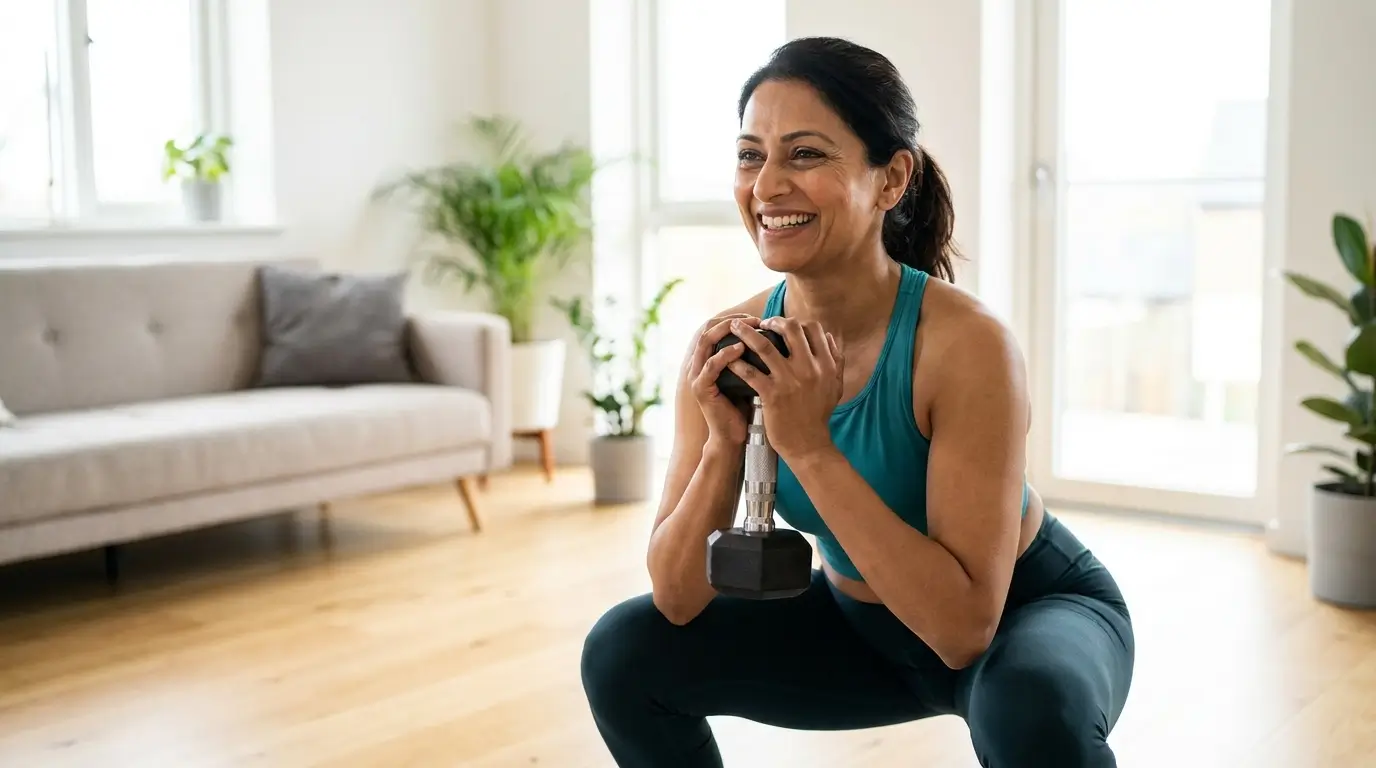
Goblet Squat or Bodyweight Squat
Stand feet shoulder-width apart, toes slightly outward. Lower yourself as if sitting back into a chair, chest up, knees tracking over your toes. Drive back up through your heels. Start with bodyweight, progress to a water bottle, then a light dumbbell at your chest.
The squat is the most important lower body exercise available, building the muscles most critical for daily function, fall prevention, and metabolic health.
Glute Bridge
Lie on your back, knees bent, feet flat on the floor. Push through your heels and drive your hips toward the ceiling, squeezing your glutes firmly at the top. Lower slowly.
Glute bridges directly address the largest muscle in the body, one of the most undertrained in women who sit regularly. Strong glutes protect the lower back and boost metabolic rate.
Modified Push-Up
Begin with knees on the floor, hands slightly wider than shoulder-width. Lower your chest toward the floor and press back up. As strength builds, progress toward full push-ups with knees off the floor.
Upper body pushing strength is often neglected in women's fitness programs. It builds the chest, shoulders, and triceps while demanding significant core stability.
Bent-Over Row
Stand feet hip-width apart, hinge forward at the hips until your torso is roughly parallel to the floor, back straight. Hold a water bottle or light weight in each hand. Pull your elbows back and up, squeezing your shoulder blades together, then lower with control.
The most important upper body pulling exercise for women over 40, directly building the mid-back muscles responsible for posture, chronically weak in most women who sit.
💪 Want to Build Strength Safely After 40?
Discover top-rated resistance bands, light dumbbells, and joint-friendly workout gear that actually work.
👉 See Strength Training ProductsStep-Up
Stand facing a step, low box, or sturdy chair. Step your right foot onto the surface, drive through your right heel to bring your body up, then step back down with control. Alternate legs.
Step-ups directly train the balance and single-leg stability that become increasingly important after 40, mimicking the demands of stairs and uneven surfaces.
Plank Hold
Place forearms on the floor with elbows under shoulders. Hold your body in a straight line from head to heels, no sagging hips, no raised backside. Breathe steadily throughout, building toward 45 to 60 seconds.
Core strength is essential for spinal health, posture, and the safe performance of every other exercise, protecting the lumbar spine rather than compressing it.
Wall Sit
Stand with your back flat against a wall. Slide down until your knees are bent at approximately 90 degrees, thighs parallel to the floor. Hold the position.
Wall sits build lower body endurance through sustained isometric contraction, no joint impact, and a direct challenge to the muscles most needed for daily mobility and independence.
Your 12-Week Progression Plan
Bodyweight versions of all exercises, focusing entirely on form. Rest 60 seconds between sets.
Add light resistance where applicable, a filled water bottle for rows, a light dumbbell for squats. Increase plank and wall sit holds by five seconds per week.
Increase resistance slightly again. Reduce rest periods from 60 to 45 seconds. Add a fourth set to two exercises per session.
After 12 weeks, your body has adapted significantly and you are ready for a more structured intermediate program.
Nutrition to Support Strength Training After 40
Training stimulus alone is not enough. What you eat directly determines how much of that stimulus translates into muscle preservation and growth.
Protein Is the Priority
Aim for 1.6 to 2.0 grams per kilogram daily, spread across three to four meals. For a 65kg woman, that is 104 to 130 grams a day, significantly more than most currently consume.
Calcium and Vitamin D
Both matter more after 40 and are critical for bone density. Dairy, fortified foods, leafy greens, and sensible sun exposure all contribute. Discuss supplements with your doctor if needed.
Eat Enough Total Calories
Severely restricting calories while training undermines muscle building and leaves you fatigued. A moderate deficit of 300 to 400 calories is appropriate for fat loss alongside training.
Common Fears, Addressed Honestly
"I will get too bulky."
Women do not produce enough testosterone to build the bulky musculature seen in male bodybuilders. Strength training for women produces a lean, defined physique, not bulk. That look comes from years of very high intensity training with specific programming and diet, it does not happen accidentally.
"My joints cannot handle lifting."
Properly progressed strength training almost always reduces joint pain rather than causing it. The muscles built through training support and protect the joints they surround. Start light, progress gradually, and prioritize form.
"I am too old to start."
The research is unambiguous, strength training produces significant muscle and strength gains in women in their forties, fifties, sixties, and beyond. Starting later does not eliminate the benefit, it just means starting later.
Quick Start Checklist
- Three sessions a week, at least one rest day between them
- Bodyweight first, add resistance gradually over the 12 weeks
- Form before load, always
- Hit your protein target daily, it makes the training count
- Give it 12 weeks before judging the results
Final Thoughts
Strength training after 40 is not about defying aging. It is about engaging with it actively and intelligently, building the physical capacity that allows you to live fully, move freely, and feel genuinely strong in a body that supports rather than limits you.
The routine in this guide takes less than 45 minutes, three times per week, no gym membership and no expensive equipment required. Start this week. Not perfectly, just start. In twelve weeks you will feel the difference.
🔥 Don't Miss These Top Health Products
See what actually works — backed by real user reviews.
👉 Click Here to See ProductsWe may earn a commission if you make a purchase, at no extra cost to you.