
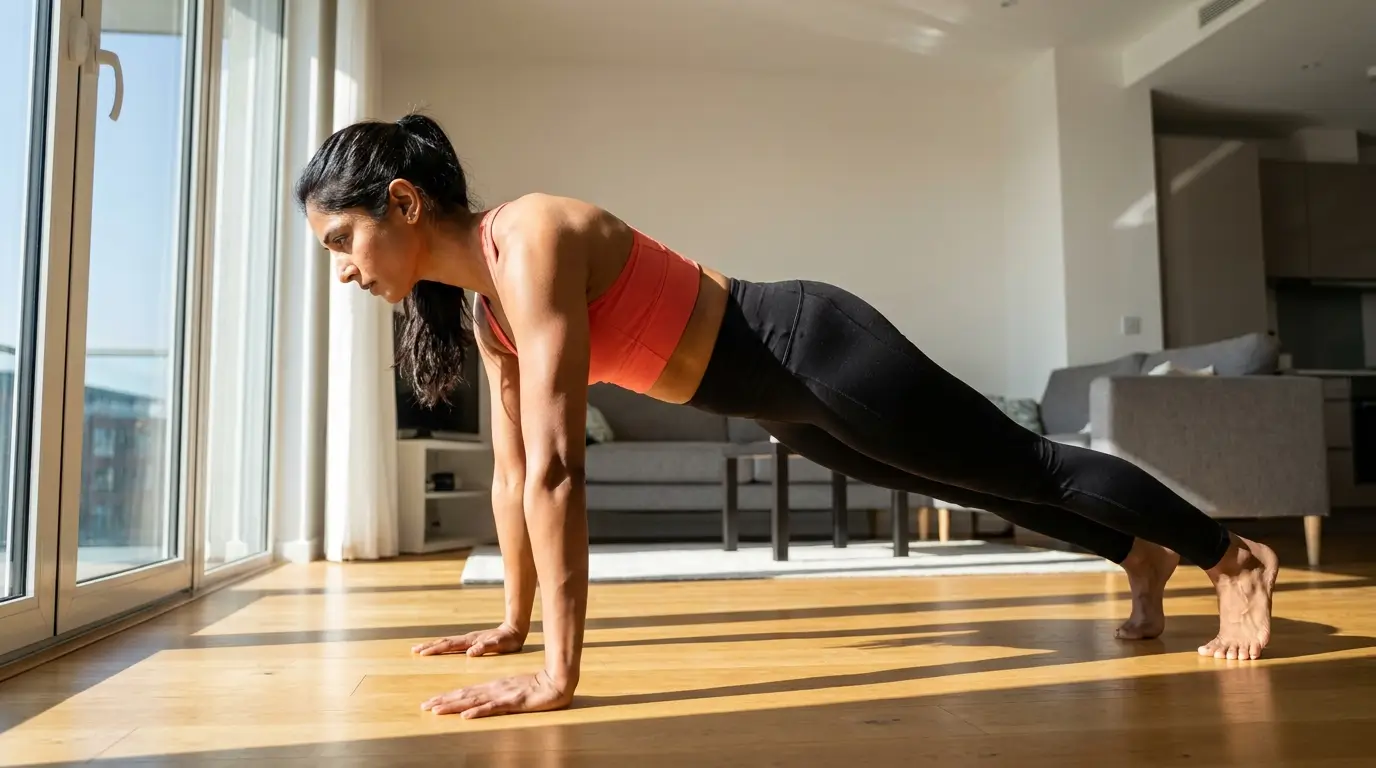
There is a persistent myth that building muscle requires a gym membership, a rack of dumbbells, and at least an hour to spare. Along with it come others: "you cannot really build muscle without weights" and "bodyweight training is just for toning." Research does not support those claims.
Muscle grows in response to progressive mechanical tension, the stress placed on muscle fibres when they are challenged near their capacity. That tension can come from a barbell, or it can come from your own bodyweight, applied intelligently through the right exercises, tempo, and progression. No equipment required, no gym required, not even a lot of space required.
Can Women Actually Build Muscle Without Weights?
Yes, especially if you are a beginner. Studies comparing lighter-load and heavier-load training, and even push-ups against bench press, have found similar muscle growth when sets are taken close to fatigue (see the sources at the end of this post). The key principle is progressive overload, consistently increasing the challenge placed on the muscle over time so it continues to adapt rather than maintaining the current level of strength.
With weights, progressive overload is obvious, you add more weight to the bar. Without weights, it is achieved through other mechanisms.
Increasing repetitions, doing more reps of the same exercise with proper form
Slowing the tempo, particularly the lowering phase, which keeps the muscle under tension longer
Reducing rest periods, increasing the density of the workout
Progressing to harder variations, moving from a regular squat to a single-leg squat, or push-up to archer push-up
Increasing time under tension, adding pauses and holds at the most challenging point of the movement
A woman who progresses from knee push-ups to full push-ups to archer push-ups over twelve weeks has applied progressive overload to her chest and triceps. Those muscles have adapted and grown stronger. This is muscle building, and no weights were involved. New to training? Start with our beginner's guide to building a fitness routine.
Before you start: if you have joint problems, a heart or blood pressure condition, are pregnant or postpartum, or are returning from an injury, check with your doctor first. Stop any exercise that causes sharp pain.
Why Muscle Building Matters for Women Specifically
Muscle is not just an aesthetic goal. It supports long-term health, which becomes more important as women age.
Metabolic Rate
Muscle burns roughly 13 calories per kilogram per day at rest. The effect is modest, but it adds up, and more muscle makes it easier to maintain your results over time.
Bone Health
The mechanical loading of strength exercises helps support bone density, which is particularly important for women after menopause.
Metabolic and Mood Health
Resistance training is linked with better insulin sensitivity and a lower risk of type 2 diabetes, and many people notice improved mood and energy.
Functional Strength
Carrying groceries, lifting children, climbing stairs without losing breath, these daily demands become easier with real muscular strength.
Body Composition
Muscle is denser than fat. Building it while at maintenance or a modest deficit changes how your body looks at any given weight.
The Muscle-Building Principles This Workout Uses
Compound Movements First
Exercises working multiple muscle groups at once, squats, push-ups, hip hinges, produce more stimulus per unit of time than isolation exercises.
Slow the Lowering Phase
A slow, controlled lowering phase keeps muscles under tension longer and makes bodyweight exercises much harder. Every exercise uses a three to four second descent.
Work Close to Fatigue
If you could easily do ten more reps, the stimulus is too low. Aim to finish each set with two to three reps left in reserve, not easy, but controlled.
Progress Regularly
Aim to improve something small most sessions, one more rep, one second slower lowering, or one fewer second of rest.
The Muscle-Building Home Workout
A full-body routine for three sessions per week on non-consecutive days, Monday, Wednesday, Friday is ideal. Each session takes 35 to 45 minutes. Complete three to four sets of each exercise. Do a few minutes of easy warm-up first, such as marching on the spot, arm circles and bodyweight squats.
Slow Bodyweight Squat
How to do it: Stand feet shoulder-width apart, toes slightly outward. Take three to four full seconds to lower yourself, sitting back as though onto a chair, chest tall, knees tracking over toes. Hold one second at the bottom. Drive back up through your heels in one to two seconds.
The slow tempo is the key differentiator here. Standard bodyweight squats done quickly are often too easy to build much muscle. Slow squats with deliberate control become a genuine strength-building exercise.
Elevated Push-Up
How to do it: Place your hands on the edge of a sofa, chair, or step, approximately knee height, slightly wider than shoulder-width. Lower your chest toward the surface over three seconds, keeping your body in a rigid straight line. Press back up.
Starting elevated reduces the load compared to a floor push-up, allowing full range of motion and proper form from the beginning. Make sure the surface cannot slide.
- 1Elevated surface push-up, sofa height
- 2Elevated surface push-up, coffee table height
- 3Full floor push-up
- 4Wide-grip floor push-up
- 5Slow push-up, three second lowering, two second pause
Single-Leg Glute Bridge
How to do it: Lie on your back, knees bent, feet flat on the floor. Extend your right leg straight. Push through your left heel and drive your hips toward the ceiling, squeezing your left glute firmly at the top. Lower over three seconds. Complete all reps on one side before switching.
Working each leg independently helps even out strength differences between your sides, which exercises done on both legs at once can hide.
Reverse Lunge with Slow Descent
How to do it: Stand feet together. Step one foot back into a reverse lunge, taking three full seconds to lower your back knee toward the floor, front shin vertical, front knee above ankle. Drive back up to standing in one to two seconds. Alternate legs.
The three-second descent creates sustained tension throughout the entire range of motion. Many people find the reverse variation easier on the knees than a forward lunge, because the front shin stays more upright.
Pike Push-Up
How to do it: Start in a downward dog position, hips high, body forming an inverted V. Bend your elbows and lower the top of your head toward the floor between your hands over three seconds, stopping just above the floor. Press back up.
Many bodyweight programs for women neglect the shoulders. Pike push-ups are an effective no-weight shoulder exercise that develops the deltoids and upper trapezius.
Tricep Dip on Chair
How to do it: Sit on the edge of a sturdy chair, hands on the edge beside your hips, fingers pointing forward. Slide forward off the seat. Lower your body bending your elbows to approximately 90 degrees over three seconds, then press back up.
The triceps make up most of the muscle on the back of the upper arm, so training them is key for arm definition. Dips challenge them through a meaningful range of motion with just a stable chair.
Hollow Body Hold
How to do it: Lie on your back and press your lower back firmly into the floor. Extend your arms overhead and legs straight, lifting both slightly off the floor, hovering just above the surface. Hold while breathing steadily, building toward 45 seconds. If your lower back arches off the floor, bend your knees.
Develops the deep abdominal muscles under sustained tension, building core strength that transfers to every other exercise in this routine.
Superman Hold with Squeeze
How to do it: Lie face down, arms extended in front of you. Simultaneously lift your arms, chest, and legs off the floor, squeezing your glutes and the muscles between your shoulder blades firmly at the top. Hold two to three seconds before lowering slowly.
Directly develops the muscles along the back of the body, which are often underused in people who spend time sitting. Stronger back muscles support posture and a healthy lower back.
The Complete Workout at a Glance
| Exercise | Sets | Reps or Hold | Rest |
|---|---|---|---|
| Slow Bodyweight Squat | 3 to 4 | 12 to 15 reps | 45 to 60 sec |
| Elevated Push-Up | 3 | 10 to 12 reps | 45 to 60 sec |
| Single-Leg Glute Bridge | 3 | 10 to 12 each leg | 45 to 60 sec |
| Reverse Lunge Slow Descent | 3 to 4 | 10 each leg | 45 to 60 sec |
| Pike Push-Up | 3 | 8 to 10 reps | 45 to 60 sec |
| Tricep Dip on Chair | 3 | 10 to 12 reps | 45 to 60 sec |
| Hollow Body Hold | 3 | 20 to 30 sec hold | 45 sec |
| Superman Hold with Squeeze | 3 | 12 reps | 45 sec |
Over 40, or want a gentler start? Our strength training guide for women over 40 covers a lower-impact beginner routine.
Nutrition to Support Muscle Building at Home
Training provides the stimulus. Nutrition provides the raw materials. Without adequate nutrition, even perfect training produces suboptimal results.
Protein Is the Priority
Research suggests most of the benefit comes at around 1.6 grams per kilogram daily, and up to 2.0 is a reasonable upper range. For a 60kg woman, that is roughly 96 to 120 grams, spread across three to four meals.
Eat Enough Total Calories
Severe restriction while building muscle is counterproductive. Eating around maintenance, or a small surplus, supports muscle gain. If fat loss is also a goal, keep the deficit modest and protein high.
Spread Protein Through the Day
About 20 to 40 grams per meal, including one after training, is a practical way to reach your daily target. Total daily protein matters more than exact timing.
Want desi meal ideas? Try our high-protein desi breakfast recipes and the 7-day high-protein desi diet plan. If you are cutting calories as well, read how to preserve muscle while losing weight.
How to Progress Over 12 Weeks
Learn the movements. Focus entirely on form and the three-second lowering tempo. Three sets per exercise.
Add a fourth set to two exercises per session. Begin progressing to harder variations where three sets feel manageable.
Progress to harder variations across all exercises. Introduce two to three second pauses at the most challenging point.
Reduce rest from 60 to 45 seconds. Add one more challenging variation to each exercise. It should feel significantly harder than week one.
When this routine starts to feel easy, step up to the 30-minute advanced full-body workout. Prefer fat loss exercises? See the best bodyweight exercises for fat loss.
Quick Start Checklist
- Train three times a week on non-consecutive days
- Slow the lowering phase to three to four seconds on every exercise
- Leave two to three reps in reserve, not zero, not ten
- Hit your protein target every day, not just on training days
- Progress one small thing most sessions, reps, tempo, or rest
Final Thoughts
Building muscle as a woman without weights is not a compromise or a consolation. It is a legitimate, effective, and sustainable approach to developing strength, body composition, and long-term health, especially in the first months of training.
What matters is not the equipment. It is the progressive overload, the adequate protein, the consistent effort, and the patience to give the process the weeks and months it requires. Show up three times a week, work with genuine effort, and trust that the slow, steady process of muscle adaptation is happening. Stay consistent. Stay patient. Stay strong.
Looking for Home Workout Gear?
Browse fitness and health products from our partner network.
Sponsored link. We may earn a commission if you make a purchase, at no extra cost to you.
See ProductsCommon Questions About Building Muscle Without Weights
Quick, straight answers to what women usually ask before starting.
Yes, especially as a beginner. Muscle grows from progressive mechanical tension, which can come from a barbell or from your own bodyweight applied through slower tempo, harder variations, reduced rest, and more reps, as long as sets are taken close to fatigue.
Train the whole body three times a week with bodyweight exercises such as slow squats, elevated push-ups, glute bridges, lunges and holds. Lower slowly, finish each set with two to three reps in reserve, and progress to harder variations over time while eating enough protein.
Three sessions a week on non-consecutive days, such as Monday, Wednesday, and Friday. This gives enough stimulus to build muscle while allowing recovery between sessions.
Many beginners notice strength gains within 3 to 4 weeks, largely from learning the movements. Visible changes usually take longer, often 8 to 12 weeks or more, and vary from person to person.
No. This routine uses only your bodyweight plus a sturdy chair or sofa edge for a couple of exercises, nothing that needs to be purchased.
Research suggests about 1.6 grams per kilogram of bodyweight daily captures most of the benefit, and up to 2.0 is a reasonable upper range. For a 60kg woman, that is roughly 96 to 120 grams a day, spread across three to four meals.
Start with the elevated version, hands on a sofa or chair edge, then progress to a coffee table, and finally the floor as your strength builds over several weeks.
Sources and Further Reading
- Schoenfeld BJ, Grgic J, Ogborn D, Krieger JW. Strength and hypertrophy adaptations between low- vs. high-load resistance training: a systematic review and meta-analysis. Journal of Strength and Conditioning Research, 2017.
- Kikuchi N, Nakazato K. Low-load bench press and push-up induce similar muscle hypertrophy and strength gain. Journal of Exercise Science and Fitness, 2017.
- Morton RW, et al. A systematic review, meta-analysis and meta-regression of the effect of protein supplementation on resistance training-induced gains in muscle mass and strength in healthy adults. British Journal of Sports Medicine, 2018.
- Wang Z, et al. Specific metabolic rates of major organs and tissues across adulthood. American Journal of Clinical Nutrition, 2010.
- U.S. Department of Health and Human Services. Physical Activity Guidelines for Americans, 2nd edition, 2018. Recommends muscle-strengthening activity on at least two days a week.